Well, as you will have gathered from the previous post, we are now pretty well settled in Nanjing, and aware of how quickly time is passing. I have taught my first class, and, as I like to say, at least no one threw any tomatoes! But I'll write more about that another time.
Today I want to turn to an avocational interest of mine, architecture. Anyone who comes to urban China today can't help but be impressed by all the building. The Beijing Olympics represented perhaps the apex of Chinese money in search of world-class architects, with some stunning results (if also some widespread destruction of Beijing's built past). Nanjing, too, is undergoing rapid change as big money acquires and rebuilds old city blocks. Nanjing University is also taking part in the building boom, now in the process of building its third (and newest) campus.
The home campus, where Jill and I are headquartered, represents in its buildings much of twentieth-century China, and not always to the benefit of the campus appearance. Now more than 100 years old, Nanjing University inevitably reflects the complicated history that gave the world today's China.
One page of that history has interested me for some time--namely, the connection between the original university campus and the Chicago architectural firm of Perkins, Fellows and Hamilton. Students of America's Prairie School architecture will know that Dwight Perkins was a first-cousin of Marion Mahoney Griffin, spouse and partner to Walter Burley Griffin, whose Ricker House on Broad Street is one of Grinnell's finest buildings. And it was Dwight Perkins who in 1913, just when the Griffins were moving to Australia where they hoped to design the new capital, Canberra, recommended Griffin to the University of Illinois as Chair of the Department of Architecture.
What may be less-well known is that Perkins's colleague, William K. Fellows (1870-1948), was apparently the main architect for a whole collection of buildings at Nanjing University. Perkins, Fellows & Hamilton in fact designed many schools, principally in the US Midwest, so it is hardly surprising that the firm should also have designed a university. But exactly how they came to design Nanjing's university is not clear—at least not yet to me, although I hope to improve on my ignorance while I am here. But an article in the January 28, 1925 issue of The American Architect reports that "Through the recent activity of Mr. J. E. Williams, of the University of Nanking, money was given toward the building and endowment of a greater university" (58). Among the donors was Mrs. Cyrus McCormick of Chicago (who endowed the first four dormitories), a Mr. Swasey of Cleveland (Science Building), Mr Severance (administration building), and a Mr. Day (chapel). A the time of this article's publication, more construction was anticipated for yet another science building and a hospital group.
According to the article, the architects visited China so as to "familiarize themselves with the materials used and the methods of construction employed and also with the architectural features of the country." The new buildings were constructed over "old and deserted grave land on the outskirts of the city," and represented what the authors describe as an "acropolis" rising above the lower-lying land south of the new complex.
What strikes the eye of a prairie school enthusiast is the way in which so many features of that architecture meld with designs intended to be Chinese. All the main buildings were made from brick, "not the small familiar brick of commerce," reports The American Architect, "but brick taken from the old wall of the Manchu city, made hundreds of years ago and some with inscriptions of a former generation. These brick are 4 x 8 x 16 inches in size and weigh about fifty pounds apiece" (64). The trim was made from white marble, still quite resilient now almost a century later. Roofs were all tiled, and ornamented with cornices intended to evoke more typical Chinese designs. Nevertheless, in numerous details—including the window muntins, the design of door decorations, and even—as on the chapel—the long ribbons of window so often found in Prairie School buildings.
The dormitories apparently formed a set of quads to the west. To judge from the original plan, several of these buildings disappeared when the athletic fields and gymnasium were built. But today one can still enjoy a very pleasant quadrangle that originally served as dormitories but today houses various other offices and departments. These buildings relied upon brick of more conventional dimensions (and origins, one presumes), but retained many of the same design features.
There is much more one might say about all this, and I promise that, if I manage to learn more about these buildings, I will try to restrain my blog enthusiasm on this score. Still, the buildings—recently very carefully repaired and repainted, no doubt for the university's centennial—reflect an earlier form of cooperation between the US Midwest and the University.
Wednesday, February 23, 2011
Monday, February 21, 2011
What's to see in China? ...Did you say "IKEA?"
Yeah, I know. China, land of thousands of years of history, land of remarkable beauty, numerous world-class museums...and where did we go on Saturday? To IKEA, like many thousands of Chinese, it turns out. I admit that I've been to IKEA in the US several times, and I've seen IKEA in Russia, Hungary, and other places, but I was curious about how the IKEA phenomenon played out in today's China. After all, when I first saw China in 1982, there were way more bicycles than cars, and the consequences of the Cultural Revolution were still palpable everywhere. But today's China is a different place, especially for people of a certain age, education, and, most importantly, income, and nowhere better illustrates this reality than IKEA. Here in Nanjing, as with IKEA everywhere, I guess, the store is situated out some distance, bumping up now against other big box stores. And, as in Chicago's IKEA, for instance, there is a huge parking lot and lots of cars. And, as in all IKEA stores, one can find countless attractive and (usually) low-priced items of consumption; indeed, surveying the items for sale, it would be hard to notice any difference from any IKEA store—every item labeled in Swedish, as elsewhere, but here also labeled in Chinese.
All IKEA stores attract crowds, but until I visited the Nanjing IKEA I really had no appreciation for the meaning of "crowd." The store was crammed with people, for the most part young, well-dressed couples, often with a child (sometimes even two) in tow. As in all IKEA stores, they were toting those ample yellow bags suitable for filling with lots of stuff; more ambitious buyers had shopping carts they were filling, and filling their bags and carts they certainly were! As their buying habits suggested and as their clothing generally confirmed, these were the young Chinese who were benefiting from the changes of the last two decades. Unlike their un- or under-employed peers, these people have a stake in the system.
I have thought about all this quite a bit of late, especially in light of the instability now apparent elsewhere in the world over the last few weeks. Although a recent piece in the New York Times indicated an awareness in China of a potential carry-over from the turbulence evident throughout the Middle East, it is hard to visualize this threat among the throngs of young Chinese we saw at IKEA; for them things here seem to be just fine. Of course, it is impossible to know how broadly this satisfaction extends, and far from all young Chinese can afford to shop at IKEA (or buy the car to get them there). But for a generation born not only after the Cultural Revolution but even after Tienamen, it may well be stuff that determines the future of China.
Wednesday, February 16, 2011
Guilin
All the guidebooks report that the area around Guilin has long been spoiled by its popularity with tourists, and it is hard to dispute this contention. Tourists are everywhere, and there are nearly as many hawkers trying to sell postcards, tours, bicycle rides, and much else. So there is that--people trying to make a living out of the tourist trade.
But the landscape, seemingly perforated by enormous limestone karsts long ago pushed violently upward by geologic pressures, inspires wonder and explains why so many tourists have been drawn here. The Li Jiang, the principal river in the district, now seems a slight force of nature—a broad but mostly dry, rocky channel—but at one time the river helped carve out the landscape that confronts today's tourists. And tourists there are in abundance! Some travel the river in small skiffs fashioned from a dozen or so large bamboo poles fastened next to one another and capped at the ends (often with pieces of automobile tires) to keep the river's water out; perhaps four or six chairs sit on the deck with a small covering overhead; at the rear sits the single boatman operating a very small outboard motor that gently propels the craft forward, the river's water gently washing over the deck. Modern variations of this boat depend not upon bamboo but upon a dozen PCV tubes, often capped not with automobile tires but with PCV caps such as your household plumber might stock. Some larger craft navigate the river, too, but the channel is neither deep nor wide, so all the boats must accommodate themselves to this reality.
No matter how you view the jagged landscape around Guilin, the impression is powerful. Andrew, Xian Na, Jill and I signed up for an all-day tour that began with a bus ride out of town, visiting several spots along the way where we might sample the different shapes of Guilin's geology. Being so far south, Guilin enjoys a milder climate than northern China, so we noticed that many forms of plant life prospered here even in February. For example, Jill had noticed on the plane trees that lined one of the downtown streets that ferns were freely growing along the bark, and we saw palms, cycads, birds' nest ferns, and much else that will not grow outdoors further north. More impressive still was an enormous banyan tree we encountered at one of our stops. According to the posted sign, experts estimated the tree to be about 1100 years old, its various spreading branches held upright by a network of younger stems.
After lunch we all entered a cave that opened up within one of these enormous rocky thrusts. Riding part of the way in a sort of canoe, then later walking through a network of pathways and stairs, we enjoyed the illumined topography—hollowed out caves, tall stalagmites, dangling, undulated stalactites—generated by the mineral-rich waters that had long made their way through this limestone. Sadly, the way out of the cave led through an intricately-designed, one-way path that passed absolutely every conceivable salable memoir of the adventure! But the cave trip made it possible to think about the interiors of these monstrous projections that lined the horizon all around us.
Of course, one need not travel far to enjoy Guilin. In an effort to recover a bit from all the excitement of the wedding and travel, the four of us got a late start one morning, and used the day to explore Elephant Trunk Hill (it seems that all the hills have been given names intended to reflect their appearance) situated right in town, but rising sharply above the Li Jiang. We also strolled along the lake by our hotel, decorated with a pagoda now serving as a tea house.
And on our last day we enjoyed a sunny stroll through Quixing Park on the city's east side. The breeze was a bit stiff, but the sun brought out families and it was fun to watch little kids chasing after wind-blown bubbles, or running wildly after one another with parents or grandparents close at hand. In such a scene it was impossible to miss those basic joys and ambitions that unite all persons, no matter where they live.
Monday, February 14, 2011
Wedding--the Guests
By now you must be tired of reading about the wedding, now almost a week old. But I thought I would add one more post to say something about the guests. As I wrote earlier, even before the wedding began a series of seats had been placed adjacent to the red carpet for the kids to occupy, giving them unobstructed views; everyone else crowded in behind, catching as much of the action as they could. As the photo shows, quite a few kids attended, but perhaps none so cute and excited as Chen Yue, a niece, I guess you could say, of Xian Na, and her little friend, both of whom accompanied us on a walk up the nearby hill where they collected some flowers for the bride. During the ceremony, too, Chen Yue stayed close to the action, and enjoyed checking out the digital photos I was trying to take of the ceremony. But she was far from the youngest to attend, as several babies arrived, saddled onto their mothers' backs in a wrapped, warm basket.
At the opposite end of the age spectrum were some older locals who arrived to attend yet another in what must have been a lifetime of village weddings.
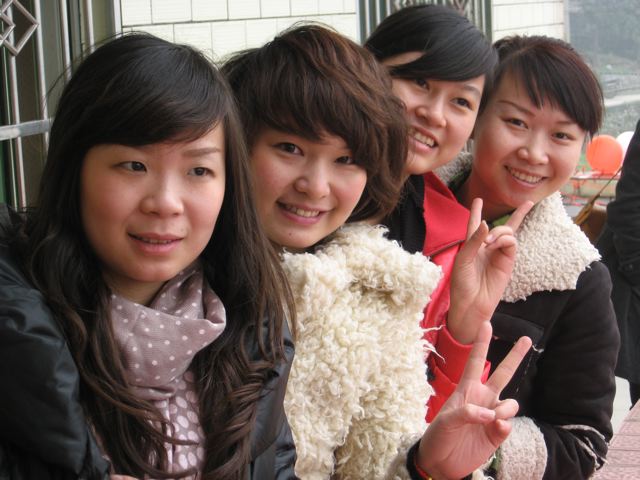
Of course, there were visitors in attendance, too. Several of Xian Na's classmates from Chongqing Technical University (who also were once students of Andrew's at the University) came and helped, and Aaron, the master of ceremonies, had long been a friend and colleague of Andrew's at Chongqing Technical University.
And then too, there were the parents, who here posed with the bride and groom, nicely illustrating how the wedding brought together two families. Next to me is Tang Xiao Min, Xian Na's mother, and next to Jill is Xian Na's father, Xian Si Zhong.
OK, I'll give it a rest. The wedding was a wonderful time, but in my next post I'll move on to tell you how we spent a few days relaxing around Guilin in southern China.
Saturday, February 12, 2011
Wedding, Part 3
When I was a boy, all the weddings at our church were community affairs: the "receptions," as they called them, always took place in the basement of the church, and the women of the church did all the cooking, baking, and cleaning up. I never thought much about it then, but I have come to learn that in many cultures of the world weddings have similarly been community affairs. In these places--like Russia, for instance--weddings were celebrated not so much for the bride and groom as they were for their parents, all their kin, and neighbors. A wedding meant that sometime soon the community might expect new additions, and this prospect was important for everyone. Consequently, Russian weddings might stretch out over three days, and featured numerous feasts with the bride's and groom's families. And, as with all feasts, someone had to prepare all the food! I thought about all these things as I observed preparations for the wedding of Xian Na and Andrew.
When we arrived at Xian Na's house the day before the wedding, preparations were already well underway. I can't remember all the preparations, but the photos here will point to a few moments in the process. You will notice that here, too, women did most of the work--some trimming and chopping the meats, some the bamboo shoots and vegetables, some preparing the rice. Men were present although, except for setting up the dozen or so tables (where they soon situated themselves to play cards or mahjong), men did not do much of the actual preparation--at least so far as I could see.
With all this preparation, the obvious follow-up was to eat, and eat we all did! The main meal the day before the wedding was quite delicious, though perhaps somewhat less special than the next day's meal. Guests enjoyed a half-dozen dishes at each table along with generous portions of rice (check out the size of that rice steamer!). The guests, of course, were not limited to the wedding party or their families, but everyone in the neighborhood! Because the Spring Festival was still officially underway, many villagers, who had moved elsewhere or had left the village to work elsewhere, were home for the holiday, so there were many mouths to feed.
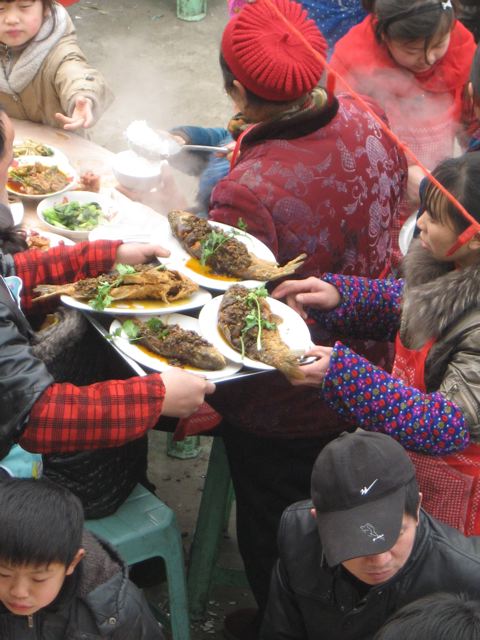
Each of the dozen tables accommodated about eight persons, so each "shift" fed almost 100 people. On the day of the wedding, the first "shift" went to those who had attended the ceremony, and the tables groaned with a variety of foods, generally richer and "meatier" than the previous day's meal. For instance, each table received a fish that had been fried whole, then basted with spicy sauce; there were roasted pork thighs, plates of marinated beef and sliced sausage, a special bamboo shoot soup and another in which a kind of turnip was boiled along with leafy greens (and of course, rice). During the meal, men and women brought a seemingly endless line of dishes out to the tables where women were posted to make sure that every table received the full menu.
While all this was going on, additional guests were arriving, waiting by the gate for the next shift to be fed. And before long, the first guests finished their meals, arose and departed; immediately someone arrived to clean off the dishes, remove the old plastic table covering, and get ready for yet another sitting. Meanwhile, a detachment of helpers set up shop outside the gate: one would scrape the remains of dirty dishes into buckets; another would wash the dishes; yet another would wash the chopsticks, etc. Soon more guests were being fed, more arrivals were waiting at the gate, and so on. At least three full "shifts" were fed before the wedding party sat down for its dinner. A circle of those who remained gathered around, doubtless curious to see the foreigners up close and see how they dealt with their chopsticks!
So, in addition to the festive wedding, in addition to the civic act by which the state recognized the marriage, a generous community meal helped celebrate and make official the community's recognition of yet another married couple.
Friday, February 11, 2011
Wedding, Part 2
It is hard to sort out the various impressions of Andrew's weddings, but I am going to try, even though I realize that doing so simplifies and understates the whole event. But in this post I want to try to set the scene a bit better than I was able to do earlier. Then I hope to follow up with another post better describing how the entire community and Xian Na's relatives joined together to make the wedding happen.
First, as I may already have indicated. Xian Na's family lives in the countryside, more than an hour outside Chongqing, the huge metropolis where Andrew taught for the first four years he lived in China. Although the cash economy is omnipresent in China, life in the countryside depends upon more than money. Everyone farms, and most food comes from nearby--from one's own plots or from the contributions of neighbors. So, despite the very hilly, almost mountainous terrain typical of the region, residents in Xian Na's village have over the generations carved out an impressive network of plots, some in low-lying regions (typically devoted to rice), and others fashioned by centuries of terracing almost all arable from the numerous hillsides surrounding the village. The result can be visually surprising, as various tended crops snake back and forth across and down the hillsides. But in addition to crops, the hills are also home to the tombs of ancestors, and one can see many tombs dotting the hillside. These were especially prominent now because, during the Spring Festival, relatives set off numerous firecrackers at the sites of the tombs, an effort which once perhaps was intended to frighten away ghosts or other undesirables, but which nowadays perhaps just as forcefully serves to remind people of those who went before them, and honor them during the celebrations. The fireworks leave behind a thick layer of red paper, a testament to how noisily the village included the deceased in the holiday.
Jill and I spent our first night after arrival in China at a hotel in Nanchuan, a small city south of Chongqing. The next day--February 7--Andrew and Xian Na, who had been staying at Xian Na's house outside town, came to collect us and by taxi take us to her home where wedding preparations were already well underway. The taxi driver would only go so far as the roads grew more tenuous, so for the last few hundred feet, we went by foot along a path that wove along and between rice paddies now awaiting a new season. But we could see Xian Na's house, festooned with balloons, immediately before us. It is a fairly large house with two full stories as well as a rooftop, several bedrooms, a first-floor kitchen, and other inside space. Nearby one could see another ten or more homes, most made of brick or faced with tile, pathways winding between and among the houses. Almost every spare piece of land was "in production," now showing various green vegetables--cabbages, various leafy vegetables, etc. A pathway wound up the nearest hill, and there one could see the formal faces of tombs as well as the patterns of green agriculture imposed upon nature's own shapes. Although electricity had long ago arrived in the village, this was nevertheless a very different world from urban China. As became apparent in the preparations already underway for the wedding, the entire network of friends and relatives were joining in to make the wedding event a success. Here, it seemed, kin and personal relations were every bit as--maybe even more--important than any other relations. When we first met Xian Na's parents, they were, as I already reported, very gracious and welcoming. Even more important, however, as Xian Na's father pointed out when greeting us, we--not just Andrew, but Jill and I too--were now part of their family.
I am posting here a few pictures to help illustrate what I have written above about the place. In my next post I hope to talk about--and show--how the community helped prepare and celebrate the wedding.
Wednesday, February 9, 2011
Wedding Festivities, part 1
I am sorry to have allowed so much time to pass, but it's been a busy week or so and connections to the internet have not always been optimal. As I write these lines, we are now in Guilin--I'll write more about that later. Today's subject is the February 8 wedding of Andrew and Xian Na, which turned out to be a fascinating and quite exciting occasion. Today I will focus upon just a few moments of the process, and add more in a later post. Xian Na's parents live about one hour outside Chongqing in a quite rural environment. One consequence of this location is that the entire community contributed to, took part in, and attended the wedding. Xian Na's parents organized what amounted to a two-day feast for everyone in the area, so the actual wedding saw perhaps 200 people--relatives, neighbors, co-workers--gather for the event. The wedding itself represented a sort of compromise between Chinese traditions and some innovations. The bride wore red, of course, and was as beautiful as any bride could wish to be. Andrew, too, wore red, looking very handsome in a jacket that he had tailored especially for the occasion. These two stood on a slightly elevated platform behind which hung a red banner with their two Chinese names inscribed upon it; and a red carpet covered the area where they stood, and reached out to the assembled guests. Xian Na's parents and Jill and I sat along the edge of the red carpet. The essence of the ceremony involved several stages. Aaron, a good friend of both bride and groom from Chongqing--who speaks both English and Chinese, introduced the bride and groom, told their story, and introduced all four parents. Then the bride and groom exchanged vows, Andrew giving his to Xian Na (in Chinese) and Xian Na giving hers to Andrew in English. Then both bride and groom participated in the tea ceremony, when both bride and groom kneeled before the parents, first to Xian Na's parents, then to Jill and Dan, giving both parents cups of tea, expressing appreciation for all that their parents had done for them, and pledging fidelity to them in the future--and received hong bao (red envelopes with cash) from each of the four parents. Then the two fathers each took the microphone to say a few words (all this being translated by Aaron), in effect giving their blessing to the couple. Then people set off various "poppers" with confetti splayed over all everyone. And then the serious eating began--about which I'll write more another time. Such a skeleton description does not approach all that the wedding represented, and I'll try to add more another time. But, despite our anxieties about something so unfamiliar to us, we felt ourselves so warmly welcomed. More than that, we felt such joy to see how much Andrew and Xian Na love one another, and felt so glad that we could be present for and share in this important moment in their lives.
Subscribe to:
Posts (Atom)